Tuesday, October 17, 2017

triangle

triangle is a polygon with three edges and three vertices. It is one of the basic shapes in geometry. A triangle with vertices AB, and C is denoted
{\displaystyle \triangle ABC}
.
Triangle
A triangle
3
{3} (for equilateral)
various methods;
see below
60° (for equilateral)
In Euclidean geometry any three points, when non-collinear, determine a unique triangle and simultaneously, a unique plane (i.e. a two-dimensional Euclidean space), in other words, there is only one plane that contains that triangle and every triangle is contained in some plane. If the entire geometry is only the Euclidean plane, there is only one plane and all triangles are contained in it, however, in higher dimensional Euclidean spaces this is no longer true. This article is about triangles in Euclidean geometry, and, in particular, the Euclidean plane, except where otherwise noted.
Types of triangle
Euler diagram of types of triangles, using the definition that isosceles triangles have at least 2 equal sides, i.e. equilateral triangles are isosceles.
By lengths of sides
Triangles can be classified according to the lengths of their sides:
  • An equilateral triangle has all sides the same length. An equilateral triangle is also a regular polygon with all angles measuring 60°.
  • An isosceles triangle has two sides of equal length.An isosceles triangle also has two angles of the same measure, namely the angles opposite to the two sides of the same length; this fact is the content of the isosceles triangle theorem, which was known by Euclid. Some mathematicians define an isosceles triangle to have exactly two equal sides, whereas others define an isosceles triangle as one with at least two equal sides.The latter definition would make all equilateral triangles isosceles triangles. The 45–45–90 right triangle, which appears in the tetrakis square tiling, is isosceles.
  • scalene triangle has all its sides of different lengths.Equivalently, it has all angles of different measure.
Equilateral
Isosceles
Scalene

Monday, October 16, 2017

Algebraic expressions

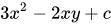
In mathematics, an algebraic expression is an expression built up from integer constantsvariables, and the algebraic operations (additionsubtractionmultiplicationdivision and exponentiation by an exponent that is a rational number).[1] For example,  is an algebraic expression. Since taking the square root is the same as raising to the power ,
is also an algebraic expression. By contrast, transcendental numbers like Ď€ and e are not algebraic.
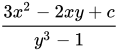
rational expression is an expression that may be rewritten to a rational fraction by using the properties of the arithmetic operations (commutative properties and associative properties of addition and multiplication, distributive property and rules for the operations on the fractions). In other words, a rational expression is an expression which may be constructed from the variables and the constants by using only the four operations of arithmetic. Thus,  is a rational expression, whereas  is not.
rational equation is an equation in which two rational fractions (or rational expressions) of the form  are set equal to each other. These expressions obey the same rules as fractions. The equations can be solved by cross-multiplyingDivision by zero is undefined, so that a solution causing formal division by zero is rejected.

Saturday, October 14, 2017

Angles

What is an Angle?

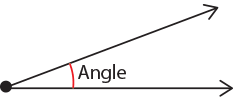
Angles are formed between two rays extending from a single point:
An angle between two rays (lines)

Angles are commonly drawn as an arc (part of a circle), as above.

Properties of Angles

Angles are measured in degrees, which is a measure of circularity, or rotation.
A full rotation, which would bring you back to face in the same direction, is 360°. A half-circle is therefore 180°, and a quarter-circle, or right angle, is 90°.
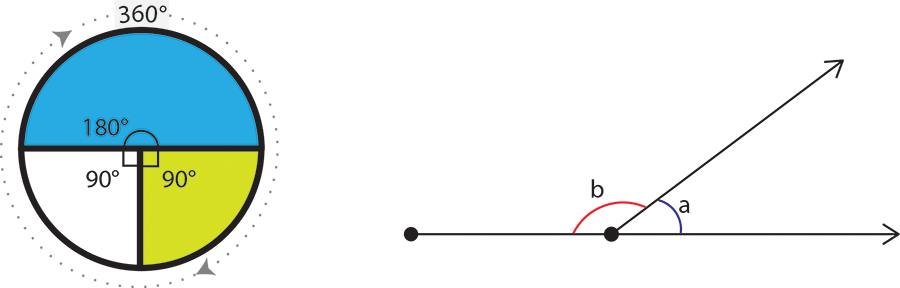
180° Angles as half a circle and shown on a line

Two or more angles on a straight line add up to 180°. In the diagram above, the circle to the left is split into three sectors the angles of the green and white sectors are both 90°, adding up to 180°.
The figure to the right shows that angles a and b also add up to 180°. When you look at the diagram like this, it’s easy to see this, but it’s also surprisingly easy to forget in practice.


Naming Different Angles

An angle less than 90° is said to be acute, and one greater than 90° but less than 180° is obtuse.
An angle of exactly 180° is said to be straight. Angles greater than 180° are called reflex angles.
Different angles can be demonstrated on a clock face. The hour hand of the clock moves round as time passes through the day. The angle of the rotation is highlighted in green.
Types of Angle: Acute, Right, Obtuse, Straight, Reflex and Complete Rotation

Opposite Angles: Intersecting Lines

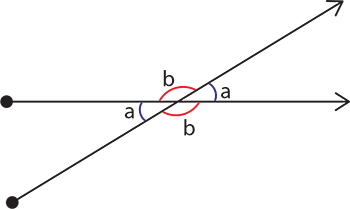
When two lines intersect, the opposite angles are equal. In this case, not only are a and a the same, but, of course, a and b add up to 180°:
Demonstrating opposite angles where lines intersect.

Intersections with parallel lines: a bit of a special case

Our page An Introduction to Geometry introduces the concept of parallel lines: lines that go on forever side by side and never cross, like railway lines.
The angles around any lines intersecting parallel lines also have some interesting properties.
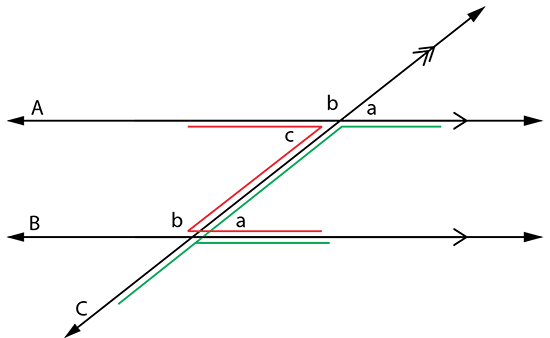
If two parallel lines are intersected by a third straight line, then the angle at which the intersecting line crosses will be the same for both parallel lines.
Line crossing parallel lines to create corresponding and an alternate angle. Z and F angles.

The two angles a and the two angles b are said to be corresponding.
You will also immediately see that a and b add up to 180°, since they are on a straight line.
Angle c, which you will realise from the previous section is identical to a, is said to be alternate with a.


Read more at: https://www.skillsyouneed.com/num/angles.html

Friday, October 13, 2017

maths basic formulas

Average formula: 

Let a1,a2,a3,......,an be a set of numbers, average = (a1 + a2 + a3,+......+ an)/n

Fractions formulas: 

Converting an improper fraction to a mixed number:

Formula for a proportion: 


In a proportion, the product of the extremes (ad) equal the product of the means(bc), 

Thus, ad = bc

Percent: 

Percent to fraction: x% = x/100

Percentage formula: Rate/100 = Percentage/base

Rate: The percent. 
Base: The amount you are taking the percent of.
Percentage: The answer obtained by multiplying the base by the rate

Consumer math formulas: 

Discount = list price × discount rate

Sale price = list price − discount

Discount rate = discount ÷ list price

Sales tax = price of item × tax rate

Interest = principal × rate of interest × time

Tips = cost of meals × tip rate

Commission = cost of service × commission rate

Geometry formulas: 

Perimeter:

Perimeter of a square: s + s + s + s 
s:length of one side

Perimeter of a rectangle: l + w + l + w
l: length
w: width

Perimeter of a triangle: a + b + c
a, b, and c: lengths of the 3 sides

Area:

Area of a square: s × s 
s: length of one side

Area of a rectangle: l × w
l: length
w: width

Area of a triangle: (b × h)/2
b: length of base
h: length of height

Area of a trapezoid: (b1 + b2) × h/2
b1 and b2: parallel sides or the bases
h: length of height

volume:

Volume of a cube: s × s × s 
s: length of one side

Volume of a box: l × w × h
l: length
w: width
h: height

Volume of a sphere: (4/3) × pi × r3
pi: 3.14
r: radius of sphere

Volume of a triangular prism: area of triangle × Height = (1/2 base × height) × Height
base: length of the base of the triangle
height: height of the triangle
Height: height of the triangular prism

Volume of a cylinder:pi × r2 × Height
pi: 3.14
r: radius of the circle of the base
Height: height of the cylinder

Thursday, October 12, 2017

mathametician ramanujans history

Srinivasa Ramanujan was born in southern India in 1887. After demonstrating an intuitive grasp of mathematics at a young age, he began to develop his own theories and in 1911 published his first paper in India. Two years later Ramanujan began a correspondence with British mathematician G. H. Hardy that resulted in a five-year-long mentorship for Ramanujan at Cambridge, where he published numerous papers on his work and received a B.S. for research. His early work focused on infinite series and integrals, which extended into the remainder of his career. After contracting tuberculosis, Ramanujan returned to India, where he died in 1920 at 32 years of age.

Intuition

Srinivasa Ramanujan was born on December 22, 1887, in Erode, India, a small village in the southern part of the country. Shortly after this birth, his family moved to Kumbakonam, where his father worked as a clerk in a cloth shop. Ramanujan attended the local grammar school and high school, and early on demonstrated an affinity for mathematics.
When at age 15 he obtained an out-of-date book called A Synopsis of Elementary Results in Pure and Applied Mathematics, Ramanujan set about feverishly and obsessively studying its thousands of theorems before moving on to formulate many of his own. At the end of high school, the strength of his schoolwork was such that he obtained a scholarship to the Government College in Kumbakonam.

A Blessing and a Curse

But Ramanujan’s greatest asset proved also to be his Achilles heel. He lost his scholarship to both the Government College and later at the University of Madras because his devotion to math caused him to let his other courses fall by the wayside. With little in the way of prospects, in 1909 he sought government unemployment benefits.
Yet despite these setbacks, Ramanujan continued to make strides in his mathematical work, and in 1911 published a 17-page paper on Bernoulli numbers in the Journal of the Indian Mathematical Society. Seeking the help of members of the society, in 1912 Ramanujan was able to secure a low-level post as a shipping clerk with the Madras Port Trust, where he was able to make a living while building a reputation for himself as a gifted mathematician.

Wednesday, October 11, 2017

number system decimal fractions

Decimal Fractions

Fractions having denominators in power of 10 are called decimal fractions.
 1/10 = .1, 2/10 = .2, ....
 1/100 = .01, 2/100 = .02, ...
 1/1000 = .001, 2/1000 = .002, ...

Converting a decimal number into a fraction

In the denominator part, place 1 under decimal point and suffix with as many zeroes as is the total number of digits after decimal point. Remove the decimal point and reduce the fraction to its lowest term.
 .56 = 56/100 = 14/25
 .0024 = 24/10000 = 3/1250
Suffixing zeroes to the right of a decimal fraction does not change its value. Thus 0.6 = 0.60 = 0.600 etc.
If numerator and denominator contains same number of decimal places, we can remove decimal signs from each number.
 2.71/3.41 = 271/341
 14.4/15.6 = 144/156 = 12/13

Adding decimals

Place each number under each other in such a way that decimal points lies in same colum. Numbers so arranged can be added in usual way.
 21.3 + .213 + 3.21 + .021 + 2.0031 = ?
 21.3
   .213
  3.21
   .021
  2.0031
 --------
 26.7471
 --------

Subtracting decimals

Place each number under each other in such a way that decimal points lies in same colum. Numbers so arranged can be subtracted in usual way.
  23.004
 -16.5628
 ---------
   6.4412
 ---------

Multiplying decimals

Multiply given numbers without considering decimal point. In product, mark the decimal point as many places of decimals as is the sum of number of decimal places in the given numbers.
 2.3 x 0.12 = ?
 23 x 12 = 276
 Sum of decimal places = 1 + 2 = 3
 ∴ 2.3 x 0.12 = 0.276

Dividing decimals by number

Divide given decimal number without considering decimal point. In quotient, mark the decimal point as many places of decimals as is the sum of number of decimal places in the given dividend.
 0.63 / 9 = ?
 63 / 9 = 7
 Decimal places in dividend = 2
 ∴ 0.63 / 9 = 0.07

Dividing decimals by decimals

Multiply both dividend and divisor by such multiple of 10 so that divisor becomes a whole number. Divide dividend without considering decimal point. In quotient, mark the decimal point as many places of decimals as is the sum of number of decimal places in the given dividend.
 0.00042/ 0.06 = ?
 0.00042/ 0.06 = (0.00042 x 100 )/ (0.06 x 100)
 = 0.042 / 6

 Now 42/6 = 7
 Decimal places in dividend = 3
 ∴ 0.00042 / 0.06 = 0.007

Recurring Decimals

Pure recurring decimals

A decimal fraction in which all figures after decimal point are repeated is called a pure recurring decimals. For example, 0.5555, 0.323232

Converting pure recurring decimal to fraction

Put the repeating figure only once in the numerator and put as many nines in the denominator as in number of repeating figures.
 Express 0.33333 in fraction.
 0.3333 = 3/9 = 1/3
 
 Express 0.2727 in fraction.
 0.2727 = 27/99 = 3/11 

Mixed recurring decimals

A decimal fraction in which some figures are not repeating whereas some of them are repeating, is called as mixed recurring decimals. For example, 0.534242, 0.078888.

Converting mixed recurring decimal to fraction

Put the difference of numbers formed by digits after decimal point taking repeated digits once and that formed by non-repeating number, in the numerator and put as many nines in the denominator as in number of repeating figures and annex them with as many zeroes as in the non-repeating digits.
 Express 0.266666 in fraction.
 0.26666 = (26-2)/90 = 24/90 = 4/15
 
 Express 0.326868 in fraction.
 0.326868 = (3268 - 32)/9900 = 3236/9900 = 809/2475